



An Alexandria graduate who is now a third-year med student, gets hands-on training at hometown hospital
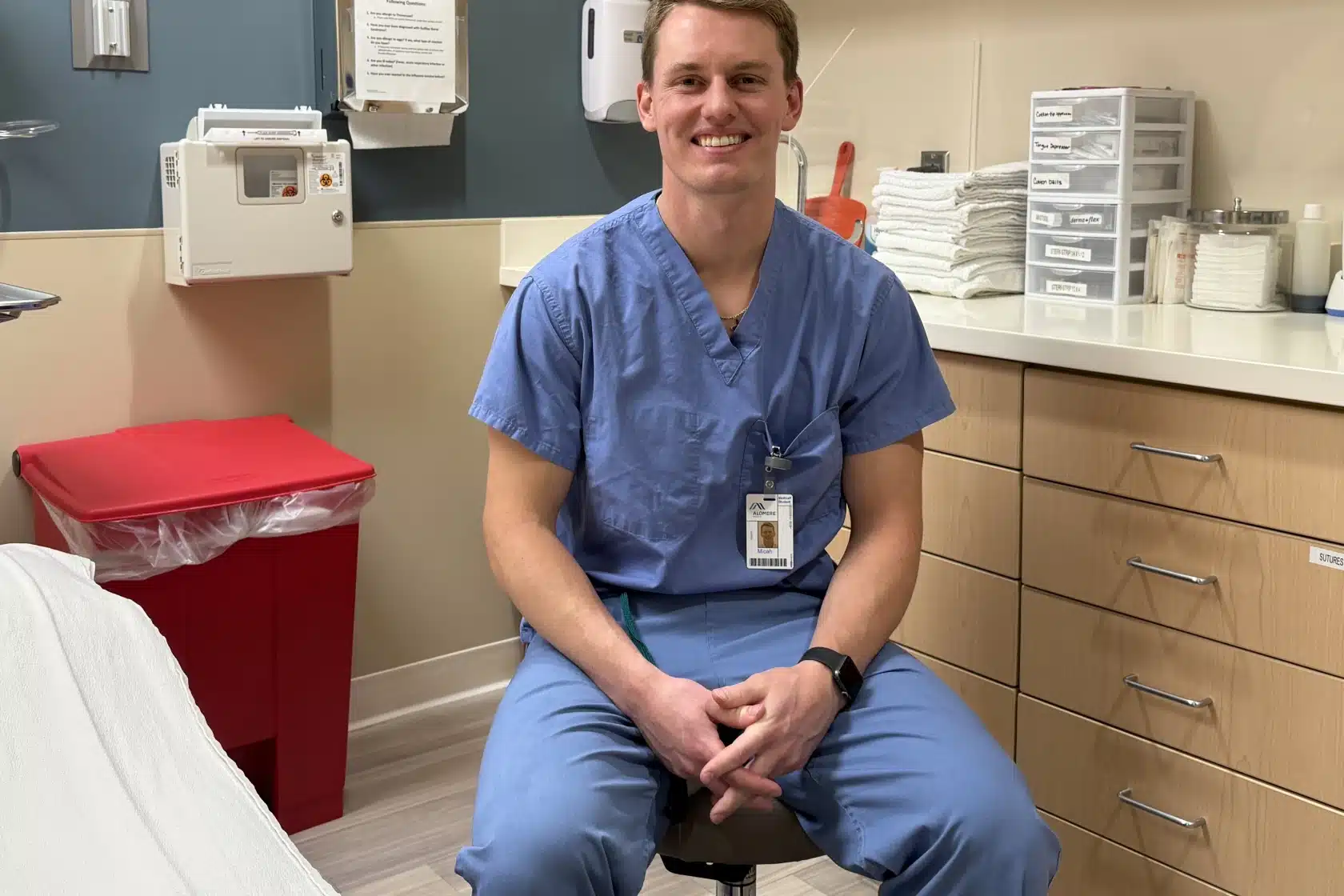
The following story was published in the Alexandria Echo Press, November 28, 2025. Story and photo credits: Celeste Edenloff
ALEXANDRIA — Micah Christenson, a third year medical student, is getting hands-on training right in his hometown at Alomere Health hospital.
Christenson, who graduated from Alexandria Area High School in 2017, is taking part in the University of Minnesota’s Rural Physicians Associate Program. The ninth-month program places medical students in rural areas of the state so they can learn directly from local physicians and better understand the realities – and rewards – of rural practice.
For his first four years of undergrad school, Christenson attended the University of Minnesota Twin Cities. He then did two pre-clinical years of med school in Duluth and is now in the middle of his third year.
Christenson said during the third year, the University of Minnesota has a plethora of different options for students. He said there are opportunities for students to remain in the Twin Cities and do their rotations at multiple different large hospitals and then there is also what he called longitudinal integrated clerkships that base students at one hospital for nine months.
The Rural Physicians Associate Program is an offshoot of that program and the program Christenson said he decided to enroll in.
“This allows students who are interested in rural health care to serve nine months through their core clerkships in a rural community,” he said. “And I was lucky enough to apply to come to Alexandria after looking at all the different sites and then get accepted to come and spend my third year here.”
Christenson chose rural medicine because he said there is no secret that rural communities are suffering disproportionately compared to urban and suburban communities when it comes to healthcare workforce shortages. He added that there are shortages everywhere, but studies from 2020 and onward show that rural areas are hit harder.
“So I think this is an opportunity for me to serve my hometown, which is a community I am particularly passionate about, help rural health care and their labor shortages and help to drive access for communities in need around here,” said Christenson.
His thoughts on the rural program
Christenson said the Rural Physicians Associate Program is pretty cool because it encourages students to do their rotations in a rural area, while also hopefully inspiring future students to become interested in rural healthcare.
Another part of the program he loves is the fact that he has to do a community health assessment, which is basically a capstone project, he said.
Christensen explained that people in the rural program have to identify a problem in the community whether it’s through a community health needs survey or by talking to local healthcare providers.
In this area, he said there has been a dip in rural students choosing to go to medical school. To combat that, he said people in the program get to participate in lectures where they can inspire and give exposure to the different health careers.
For instance, he is part of a lecture series that pertained to ER medicine. High school students get to practice intubation, sutures and even delivering a baby. There was another one where students learned about sports medicine and got to practice putting on casts.
His takeaways so far
Since he started the program in August, Christenson said there have been many takeaways and things he has learned.
“As far as my education itself, I think it’s a pretty unparalleled program where I get to serve, being this young, as an autonomous physician and learn the roles that way,” he said. “The exposure I get to seeing patients is tenfold to what I was able to get in the cities when you’re fighting with other students and residents over patients.”
He added that students in the same program he’s in get a better understanding of what it means to be a physician where they are not just seeing patients, but they are following up on lab work and communicating the results with their patients and whether or not a follow-up is needed.
He said they get to communicate with family members by setting up family meetings so they can orchestrate care or do care conferences.
“I think it just gives you a better idea of what it means rather than just going in and seeing patients and then being done for the day,” said Christenson. “And that’s very cool.”
Why did he choose medicine?
At the base of every physician there is a desire to help people, said Christenson, adding that they also have a love of science and the understanding of the human body as well as a love to help people work through things when their bodies go wrong.
This is partially true for Christenson, he said, noting that his journey was a little different and that he never thought he would end up going into medicine.
His plan? He thought he would become a nuclear engineer. However, when he made it to his capstone physics class in college and was sitting in a lab for 12 hours by himself working with circuits, he realized that becoming a nuclear engineer wasn’t what he wanted.
“I needed to talk to people. I needed to be with people. I need a social connection,” he said. “I love science and love diving deep into it so I started exploring careers that serve the purpose of my love of the sciences, while also serving my love for human connection.”
His first exposure to medicine happened to be with his dad, Dr. Mark Christenson, a veterinarian at Alex Vet Clinic. He thought that could be the career path he should take as his dad talked to people and was in the medicine world. However, after shadowing his dad, Christenson said he realized he was spending more time talking to the people and not focusing on the pets.
He began to think that maybe it was the human medicine route that he would be more suited for.
“I started getting experiences that way, whether it was scribing for the pediatrician here in town or just generalized shadowing that I fell in love with the powerful moments physicians and those in healthcare get to share with their patients,” said Christenson. “There’s the highest highs and the lowest lows and then there’s just being there for every moment in between. It is a pretty cool experience.”
Christenson will graduate from medical school in May 2027, but then he will have his residency, which can be anywhere from three to seven years depending on what specialty he chooses.
Trying to figure out what his specialty will be has been really hard because the ones he has tried so far he has really enjoyed. He said he really enjoyed the thinking that goes into internal medicine and the detective work that goes into figuring out what is going on, but he also loves the hands-on nature and immediate corrections from doing surgery. He also said he loves the continuity of care you can get from family medicine.
“With the brief time I have spent with Dr. Brown (at Alomere), I find it hard not to be in the OR,” said Christenson, who started at Alomere in August and will be there until the end of next April.
Ideally, when he is done with schooling and training, Christenson said it would be a blessing for him to come back and work in Alexandria as his wife, Kiyana (Miller), owns and operates The Edge in downtown Alexandria, and both of their families are from Alexandria.
“I think we’re pretty ingrained in this community and are definitely passionate about it,” he said. “I think if I didn’t end up working in Alexandria, it would be adjacent to Alexandria. A community that is similar to Alexandria.”
